In Life in the Clearings, Moodie’s personal reflections on the different cultural groups in Belleville represent the contradictory colonial mindset present in Canada throughout the 19th century.
On one hand, she embodied the Eurocentric, imperial attitudes of many settlers at the time; often describing Indigenous peoples and immigrants through a paternalistic lens that reinforces colonial attitudes of cultural superiority. These views reveal how deeply engrained colonial hierarchies were in her worldview.
“The red man is out of his element when he settles quietly down to a farm, and you perceive it at a glance. He never appears to advantage as a resident among civilized men; and he seems painfully conscious of his inferiority, and ignorance of the arts of life. He has lost his identity, as it were, and when he attempts to imitate the customs and manners of the whites, he is too apt to adopt their vices without acquiring their industry and perseverance...”
- From Chapter II, Sketches of Society, Life in the Clearings Versus The Bush (1853)
And yet, Moodie also demonstrated in her writing moments of empathy, and what could be considered progressive views for her era.
She acknowledged the hardships faced by marginalized groups, and at points advocated for compassion and moral responsibility toward them. She explored the complexities of social inequality, women’s struggles, and class divisions in a way that suggests a desire for reform, while simultaneously holding the cultural biases of her time.
"What a scene of fertility and beauty rises before my mental vision! My heart swells, and I feel proud that I belong to a race who, in every portion of the globe in which they have planted a colony, have proved themselves worthy to be the sires of a great nation.” - From Chapter IX, Odd Characters, Life in the Clearings Versus The Bush (1853)
This resounding tension between the opposing ideals of inclusion and colonial prejudice present in Moodie’s writing, paints a portrait of Canadian settler society – caught between entrenched imperial values and emerging humanitarian concerns. These reflections were likely very relatable to not only her fellow settlers, but also her contemporaries back home in England where movements like abolitionism were already in full swing.
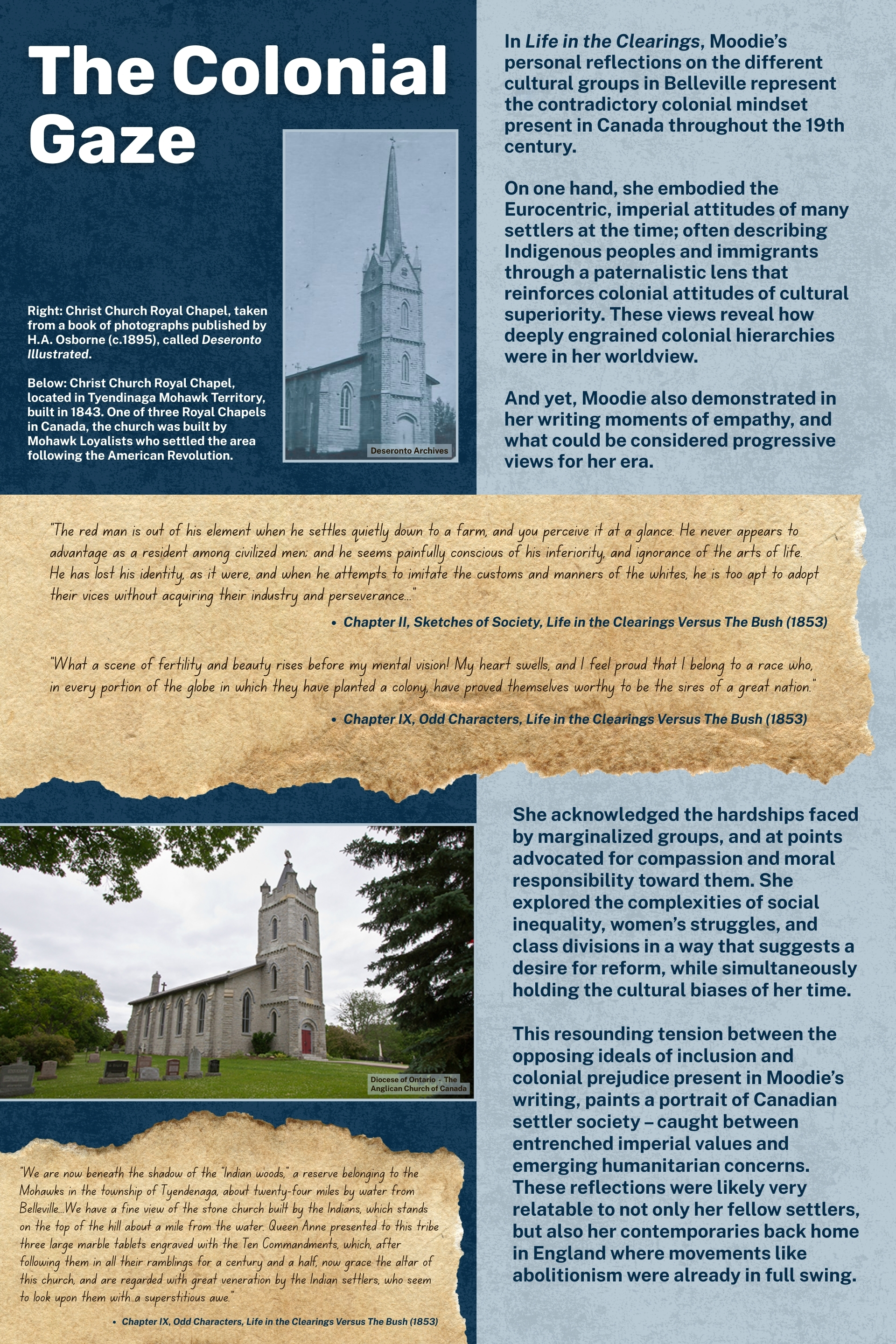
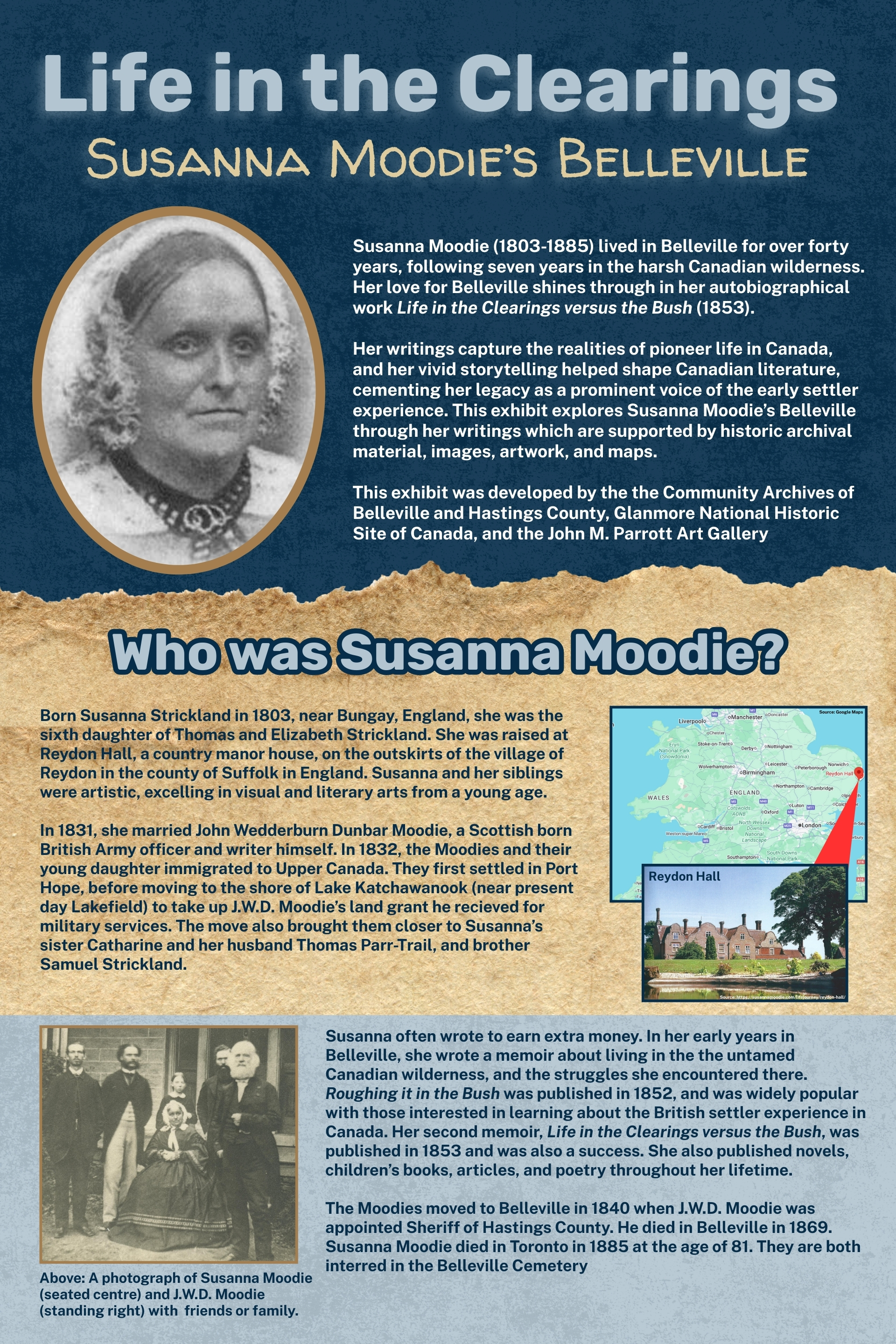
“We are now beneath the shadow of the "Indian woods," a reserve belonging to the Mohawks in the township of Tyendenaga, about twenty-four miles by water from Belleville...We have a fine view of the stone church built by the Indians, which stands on the top of the hill about a mile from the water. Queen Anne presented to this tribe three large marble tablets engraved with the Ten Commandments, which, after following them in all their ramblings for a century and a half, now grace the altar of this church, and are regarded with great veneration by the Indian settlers, who seem to look upon them with a superstitious awe.” - From Chapter IX, Odd Characters, Life in the Clearings Versus The Bush (1853)
Photographs:
- Christ Church Royal Chapel, taken from a book of photographs published by H.A. Osborne (c.1895), called Deseronto Illustrated;
- Christ Church Royal Chapel (ca. 2020), located in Tyendinaga Mohawk Territory, built in 1843. One of three Royal Chapels in Canada, the church was built by Mohawk Loyalists who settled the area following the American Revolution.